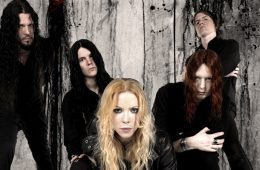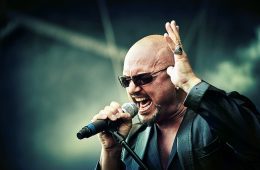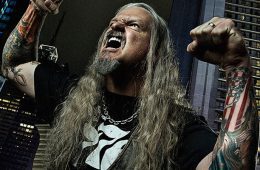
Metal Covenant recently conducted an interview with ICED EARTH guitarist/mainman Jon Schaffer. A couple of excerpts from the chat follow below.
Metal Covenant: In my point of view, the new ICED EARTH album, "Plagues Of Babylon", has definite resemblances to your latest album, "Dystopia". Was this like a conscious choice from your side or did you just write an album in the ICED EARTH vein?
Jon: Well, it's just an album in the ICED EARTH vein. I mean, the same approach was taken that we did to "Dystopia", so it's just another chapter. You know, it's what happens naturally; every record is. If you start doing something that's too contrived, then it becomes something that's not natural. Whether people get it or not, you know that's another issue, but we have to do what we're feeling at the time.
Metal Covenant: The first half of the album is a concept story. What happened then, did you run out of fuel or inspiration?
Jon: No, I just decided very early on that there's no reason to devote the entire album to this chapter of the "Something Wicked" story. I felt like we can tell it for five or six songs and we already had things like "Peacemaker" that wouldn't fit at all in the story, and I already had the music for "Cthulhu". It was different, you know. Different things were happening, and the decision to do "Spirit Of The Times" from SONS OF LIBERTY and to finally be able to do "Highwayman" with my brother singing on it, you know, that was like a big deal, so it didn't make sense to have a full concept album where "Highwayman" wouldn't have fit. It's very different, you know. It's kind of like an old RUSH record; that was the idea. Lke, "2112" was a concept on one side and on the other, it's individual tracks. Early on, that was decided.
Metal Covenant: Do you ever reflect on what's published about your new albums — you know, reviews and stuff?
Jon: I've seen some, but I don't really care. I really care more about what the fans say and I meet them and talk to them. What journalists say, I don't care. It really doesn't make any difference to me whatsoever, because it's like a lot of journalists, especially the guys that have been doing this a long time, they're so jaded and they hear so many new records. In the end, a lot of them don't even have a fresh, legitimate opinion as far as I'm concerned, so they don't really count, you know what I mean?! At the end of the day, it's the people who buy the music, who consume the music, who are the ones who pay the bills for me. Those are the fans, the people I care about. And as I said, you can tell from Facebook comments and from a lot of whatever's been put out on YouTube and stuff, the fan base is really happy. But journalists, why worry? I mean, it's really a waste of time.
Metal Covenant: ICED EARTH is like your band, it's your kind of solo project and has been for a long time. What's the best about being in a situation where you can make all the calls?
Jon: I don't really look at it that way. It's not a solo project, SONS OF LIBERTY is a solo project, you know. But I've always been the leader of this band and always will be. I mean, it's my vision and it has been since the mid-'80's. It's the thing I've been chasing all along. It's a battle, especially in the early days. The contractual conditions we were under were brutal and I don't think most people would have survived through
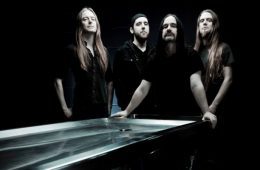
Pat Furey of Behind The Mask recently conducted an interview with guitarist Bill Steer of reactivated British extreme metal pioneers CARCASS. A couple of excerpts from the chat follow below.
Behind The Mask: You guys have a new album that dropped late last year on Nuclear Blast, entitled "Surgical Steel". I was surprised personally by the overall positive reaction that was unanimous from people. Did it surprise you given the rampant negativity that seem to infest the metal world?
Bill: [Laughs] Yeah you're right, there's a lot of that going on. I wouldn't say it was quite unanimous, because, obviously, a lot of negative comments are out there, if you look for them, but yeah, it was really shocking to us just how positive the overall reaction was, and I just really wasn't ready for that. I was bracing myself for about a 50/50 reaction, and in the end it was more like 90/10 or something. It was great!
Behind The Mask: You spoke about this being something that's been rewarding. Was there maybe any apprehension or trepidation when it came to making a new album? Were you at all fearful that people would just pass it off as not being relevant and be forgotten?
Bill: Nah, we couldn't really allow our minds to go in that direction; otherwise we would have been frozen with fear. [laughs] I guess the way we started it was, looking back, because we hadn't told anybody we were writing material. Initially it was just Dan Wilding, our drummer, and myself in a rehearsal place, and then very shortly Jeff [Walker, bass/vocals] came down and joined us, and it was a very dynamic vibe between the three of us. Every day we achieved something. Either way we came away with either an entire song or a good chunk of a song finished. And we believed in what we were doing, so other people's expectations or opinions didn't enter into it until the things was done, in all honesty, and once we had it mastered and ready to go, that was a scary time, because you just brace yourself for a load of flack, really.
Behind The Mask: With all of the reunion talk with currently defunct bands, has their ever been any talks amongst you and the guys from any incarnation in the various forms of the NAPALM DEATH lineup, talking about doing a big revival show with the revolving door of people who have been in that band?
Bill: If there has been talk, I haven't heard any. I can't see how that would be possible really, as everyone is in different places. And I don't mean geographically, but mentally and musically. If you look at the current NAPALM lineup, I only actually played with one of those people. I have been at festival where both bands were playing and people would say, "You should get up and play with them," but that would feel incredibly forced, because we didn't actually ever share a stage together in the old days. The only person I can say that about would be Shane [Embury, bass], obviously. It's a tricky one, that band, because there are so many branches of the family tree, but what I would say is that for the era of that band that I was involved in, the pivotal member — and I don't think anyone could dispute this — was Mick Harris [drums]. Really, I think in terms of getting that version of NAPALM back together, he would have to be involved, and from what I understand, that isn't really that likely.
Behind The Mask: Yeah, I've heard that he wants nothing to do with it ever again.
Bill: It might be that, or it might be more complicated, because, you know, if a guy has been away from playing blast beats and very intense drumming for a number of years, it's really hard to get back into it. So even if he had the inclination, goodness, that's going to be a real uphill struggle to get back to that point. I'm sure the present lineup of NAPALM isn't particularly bothered about doing something like that anyway.
Read the entire in
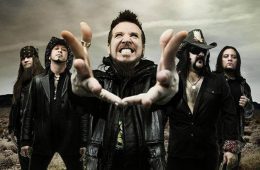
HELLYEAH's fourth studio album, "Blood For Blood", will be released on June 10 via Eleven Seven Music. The CD was helmed by producer Kevin Churko at his The Hideout Recording Studio in Las Vegas, Nevada. Churko is the Canadian musician, sound engineer, songwriter and record producer who has previously worked with OZZY OSBOURNE, FIVE FINGER DEATH PUNCH and IN THIS MOMENT, among other acts.
"Blood For Blood" is the album that HELLYEAH — featuring MUDVAYNE's Chad Gray on vocals, PANTERA's Vinnie Paul Abbott on drums and NOTHINGFACE's Tom Maxwell on guitar — has always wanted to make. "It's a defining record for HELLYEAH and for anyone on the fence," Paul declared, describing the record as "focused and with a clear direction."
After roughly eight years, three albums, countless tours as headliners and as participants on "can't-miss" festival bills and hundreds of thousands of albums sold, HELLYEAH is making their biggest and boldest statement yet with "Blood For Blood". They are going for the jugular and every song on the album clamps down and doesn't let go. They've exchanged some of the party-centric, good time sounds of past efforts for pure metallic fury and emotional introspection. The album sounds like a recharged HELLYEAH, taken up many notches.
"Blood For Blood" is easily HELLYEAH's most metallic album. It leaves a mark, thanks to songs like the angular, vengeful "DMF". There's also "Demons In The Dirt", a beast of a song birthed by the sort of anger that can't be faked; it will leave you wondering who pissed these guys off. "Gift" is dirty, rowdy rock with equal parts groove and swagger, but also possessed of the sort of punk rock energy that would make MOTÖRHEAD fans turn their heads. Then there is moodier, more contemplative fare like "Moth To The Flame" or "Hush", which connect on an emotional, cellular level, proving that you can be incredibly heavy in ways other than loud and fast.
"We still have a love affair with this band and have a lot we want to say," explained Maxwell. He relished taking on a larger songwriting role and serving as the lead guitarist, which you can hear in the album's overall sound and in every note of his playing. "That magic is there for us, still. This is the record I've always wanted to make in this band, which has so many creative forces." Gray also shared that changes made the members closer. "We leaned on each other for support and inspiration," he said.
The band opted to work with an outside producer for the first time ever, recruiting Churko for the job. "To move forward, you have to make changes," said Paul, who wrote the music in Texas with Maxwell before heading to Hideout Recording Studio in Sin City to put it to tape.
"I am used to being a producer or co-producer and I wanted to see what would happen if I backed up and let someone take the reigns, leaving me to just be a drummer," said Paul, while admitting that vocals were the one area of production to which he couldn't do proper justice. The band was happy to allow Churko to provide a fresh perspective. Given Churko's resume, which is littered with names as diverse as OZZY OSBOURNE, IN THIS MOMENT and FIVE FINGER DEATH PUNCH, the band knew he was the man who could pull the best performance possible out of Gray. The singer himself praised that Churko had a unique way of extracting what he wanted, saying, "You can be a drill sergeant and rule through intimidation or be laid back and cool, but get it done without pressure. He rules through cool."
Overall, the album has less of an obvious southern influence, with Paul deeming it "a metal record that also has melody.It lends itself to a diverse group of people."
As the mouthpiece for the band, Gray lets out his primal scream throughout the album, enabling him to properly and fully express his emotions in the music. "We want to shut people up a little, the people who have never given HELLYEAH the time of day, for whatever reason," the singer said. "Whether you want it or not, it's undeniable. This [album] is an every night fistfight." Gray shared that he firmly believes in music as therapy and revels in helping the band's fans achieve catharsis with the music they have created.
He acknowledged the fact that the album is devoid of the party anthems that previously populated the HELLYEAH catalog. "There is not a party song on this record, which we are kind of known for," he said. Gray continued "As much as I love those songs, they put us in a certain box that I've never been comfortable in since I'm not always like that." Instead, Gray and his bandmates wanted to show a depth, breadth and range of emotions and styles.
It was important for Gray to craft songs that were heavy on multiple levels at the same time. His approach was that heavy doesn't always mean as fast and as loud as possible. He said, "For me, personally, I was going through my emotional checklist, and how I wanted to be heavy both aggressively and emotionally. I need that balance." For example, the mercurial "Moth" examines our base, animal instincts and drives. Despite knowing something is bad for you and will burn you, you still can’t pull yourself away from it.
"Black December" turns a critical eye on the year-end holiday season, and more deeply, the sadness that can permeate the end of the year. "It's a deadly month and depressing," Gray explained. "It's a hard month to get through with
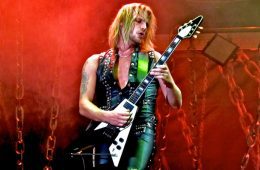
MetalTalk.net recently conducted an interview with former JUDAS PRIEST guitarist Kenneth "K.K." Downing. You can now watch the chat in three parts below. A couple of excerpts follows (transcribed by BLABBERMOUTH.NET).
On whether he missed being on the road and playing music for the fans:
Downing: "People say to me all the time, they say, 'Well, do you miss it? Go on. I know that you miss it.' And my response is the fact that after a 40-year full-on career of going non-stop, then I'm not going to miss it in the first week or month or even a year. But I guess there will come a time where I will probably think…
"I just received a really nice letter today from a guy in Costa Rica. And it was really nice to read the letter, saying that he kind of missed me in PRIEST and stuff like that. And when that happens, then it does become more and more difficult for me to take the fact that I'm no longer a part of all that. And who knows what the future holds? I mean, I don't know.
"I guess, in the scheme of things, I still consider myself to be relatively young and strong, dare I say that. And, as they say, maybe there's plenty of life left in the old dog. Who knows? But it was a long career, and the way that the industry has gone, certainly not for the better, but, obviously, as everyone knows, live performances are still fanstastically…
"If nothing else, I think that the validity of live touring and performances is stronger and more in demand than ever, really. So that's very, very healthy. At least everybody can go out there and do some live performances. And that's what bands enjoy best anyway."
On whether he keeps in touch with his former JUDAS PRIEST bandmates:
Downing: "A little bit here and there. It was just one of those situations. It's a long time — 40 years is a long, long time…
"It would certainly be difficult for me to go back into a 'songwriting and record' mode, I think, because of… I think of how much, when I look back, of how much has been achieved in that amount of time, the task of trying to get bigger and better and more unique becomes more and more of a monumental task. And I must say that when I go and see favorite bands of mine, I want them to play the songs that I know and I love, not the songs that I haven't heard yet. Will I get to grow to like these [new songs]? Well, yes, maybe. But certainly, in a live performance, you wanna rock out and sing along."
On the highlights of his time with JUDAS PRIEST:
Downing: "Probably all of it. It's like anything else. I always kind of think of, like, what's the worst and the best holiday you've ever had? If somebody had a really disastrous holiday, and you asked that person what were the highlights of that holiday years later, they probably would have said the worst things that happened were good highlights, as well as the best things. So, lots of laughs and lots of tear and the whole thing. Just collectively put together, very, very fondly cherished memories… You know, cleaning your teeth in the snow. On the side of a field in Norway, and I can remember… And it did happen, it did happen, before you get to go back to sleep in the back of the van. [The fact] that we probably had a few beers before helps things a little bit. The party has to go on."
On whether JUDAS P