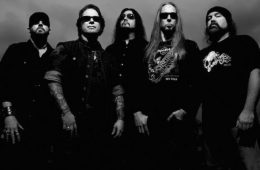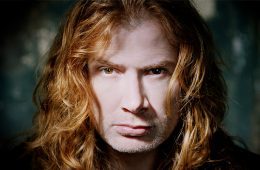
Earlier today (Wednesday, March 12), MEGADETH mainman Dave Mustaine reflected on his career, musical influences and how the band got started with Pimm Fox on Bloomberg Television's "Taking Stock".
On his upcoming performance with the San Diego Symphony:
Mustaine: "Well, the symphony music, with classical music, I believe, shows up a lot in heavy metal music. A lot of the medieval-type music that I was brought up with, and the British Invasion… LED ZEPPELIN, for example, has a lot of the story telling and the classical arrangements do tell a lot of stories. And I also was weaned on THE BEATLES, so a lot of Sir George Martin's arrangements with the strings and stuff really fascinated me. So I've always been a fan of classical music. But the classical industry is dying. There's a generation of people that don't really know about it. I thought it would be really cool to take my guitar in there and play the lead-violin part with a little bit of some snarl, a little bit of some distortion. And, you know, watching all the Disney movies when I was a kid, I liked the songs right before the poison apple gets bit, or the wolf is about to attack or something, where the music gets kind of scary. So we picked some songs that we thought were really emotional, colorful songs — some Vivaldi, some Bach."
On whether he has become less intimidating in terms of his music as he's developed:
Mustaine: "I think as you grow up, things kind of change. It's kind of hard being an anarchist when you have a Mercedes-Benz in your driveway. This morning, I was thinking about growing up, how I was homeless when I started my career. I was a product of a broken family and was, basically, watched during the day by the Boys Club Of America. And, you know, it's one of those things where you go from being a poor kid, having lunch tickets and food stamps, to being a millionaire. It's an American success story."
On some of the biggest challenges that new bands face in today's music world:
Mustaine: "The revenue streams have dried up. The money that you would generate from record sales has all but vanished. So in order to be successful and to keep yourself in business, you have to find other ways to pay your bills, which predominantly are touring and merchandise. A lot of people have endorsements and sponsorship deals and stuff like that too, but because of peer-to-peer file transferring and stuff like that — it's old news now — it's really changed the music industry."
Earlier today (Wednesday, March 12), MEGADETH mainman Dave Mustaine reflected on his career, musical influences and how the band got started with Pimm Fox on Bloomberg Television's "Taking Stock". You can now watch the segment below. A couple of excerpts follow (transcribed by BLABBERMOUTH.NET).
On his upcoming performance with the San Diego Symphony:
Mustaine: "Well, the symphony music, with classical music, I believe, shows up a lot in heavy metal music. A lot of the medieval-type music that I was brought up with, and the British Invasion… LED ZEPPELIN, for example, has a lot of the story telling and the classical arrangements do tell a lot of stories. And I also was weaned on THE BEATLES, so a lot of Sir George Martin's arrangements with the strings and stuff really fascinated me. So I've always been a fan of classical music. But the classical industry is dying. There's a generation of people that don't really know about it. I thought it would be really cool to take my guitar in there and play the lead-violin part with a little bit of some snarl, a little bit of some distortion. And, you know, watching all the Disney movies when I was a kid, I liked the songs right before the poison apple gets bit, or the wolf is about to attack or something, where the music gets kind of scary. So we picked some songs that we thought were really emotional, colorful songs — some Vivaldi, some Bach."
On whether he has become less intimidating in terms of his music as he's developed:
Mustaine: "I think as you grow up, things kind of change. It's kind of hard being an anarchist when you have a Mercedes-Benz in your driveway. This morning, I was thinking about growing up, how I was homeless when I started my career. I was a product of a broken family and was, basically, watched during the day by the Boys Club Of America. And, you know, it's one of those things where you go from being a poor kid, having lunch tickets and food stamps, to being a millionaire. It's an American success story."
On some of the biggest challenges that new bands face in today's music world:
Mustaine: "The revenue streams have dried up. The money that you would generate from record sales has all but vanished. So in order to be successful and to keep yourself in business, you have to find other ways to pay your bills, which predominantly are touring and merchandise. A lot of people have endorsements and sponsorship deals and stuff like that too, but because of peer-to-peer file transferring and stuff like that — it's old news now — it'

Mark Dean of Myglobalmind webzine recently conducted an interview with former SLAYER and current PHILM drummer Dave Lombardo. A couple of excerpts from the chat follow below.
Myglobalmind: Looking back over your extensive musical career, what have been the particular high and low points?
Dave: Well, it fluctuates; up and down, you know. A low point was probably January of last year whenever [the most recent split] went down, you know, with SLAYER. It was leading up to that, you know, unfortunately. Well, not really leading up to it, because my bags were ready and packed to go [with the band to Australia for the Soundwave festival].
Myglobalmind: It still must be difficult for you on a personal level? As they were your friends, and people that you had grown up with.
Dave: Yeah, it's strange. It's unfortunate as well, because I realize now that they weren't really my friends. They were just business partners. I lived and hung out with them, as if they were friends. "Wow, these guys are watching out for me," and it didn't quite turn out that way.
Myglobalmind: How do you feel one year on? Has your attitude to the situation mellowed, or…?
Dave: Yeah, I have, I am more, like, "Oh, well, shit happens." Move on, you know.
Myglobalmind: Are you generally a modest person about your personal musical talent and ability? How do you deal, for example, with compliments. I read, for example, that Bill Ward [BLACK SABBATH] called you “one of the best drummers in metal"?
Dave: Yeah, I am honored. First of all, I am honored to have Bill Ward as my friend. This is a guy that I looked at these albums and listened to this music, and played along to these albums as a child and a little kid. For me to know Bill, it is surreal, and it feels very odd, but it is awesome.
Myglobalmind: How do you find being a working and touring musician in the Internet age? Is it more difficult to make a living?
Dave: Well, it is.
Myglobalmind: You can't do this full time? I have talked to other guys who have established careers and still have to take other jobs because life is difficult, and can't sustain a living solely from music.
Dave: Well, the thing is you have to find other ways and get creative and find other ways to market your music and to recreate yourself. It's, like, once the Internet and the worldwide web came into the picture, everyone scrambled, and the first was the music industry, because everyone was downloading music, so they started scrambling ways to make a living. So you just have to get creative. Yeah, it is difficult. It's a little different. The royalties aren't the same from the physical CDs, but there are other avenues of income that you just need to sign up online and you will start receiving royalties on the songs that you have recorded. I never knew this until recently, about six months ago, and it was, like, "Woah, I got a nice check in the mail." All I did was just go online and register my name all the music that I did in my life that I have recorded.
Myglobalmind: That you weren't aware of, that type of royalties thing?
Dave: I was never aware of. Nobody told me, thank you fucking very much.
Myglobalmind: What about your health over the years? Playing drums at the velocity and energy levels that you exhibit regularly on stage, has that had any adverse health effects?
Dave: Nothing. Absolutely nothing. Thank God. I've been healthy. The only things that have been wrong was I broke my leg and I had to stop for only about three weeks 'cause I got straight on the drums again. They said, "No, you gotta stay off the leg. No, no." I worked it up.
Myglobalmind: It's in the blood, is it?
Dave: Yeah, I just kept going and it was great. I wrote a song and it's on the new album, the new PHILM album, with a broken leg, so… But other than that, no. I drink a lot of water. I try to stay off the booze, although I like it, but there's limits. I try to eat right and I try to walk a lot. You could really become… You could grow stagnant. You could get very lazy if you don't stay active.
Myglobalmind: Playing that type of music obviously is going to have that chance of health issues…
Dave: I started PHILM, you know, when I noticed that [SLAYER], in a way, health-wise, was crumbling, not only with Jeff [Hanneman, guitar], but with Tom [Araya, bass/vocals] and Kerry [King, guitar] doesn't take care of himself. He should be careful. Well, I'm not going to tell him that…
Myglobalmind: Nobody would tell him that.
Dave: Nobody. And I'm not either.
Myglobalmind: He's quite an imposing character, shall we say.
Dave: Yeah, of course. He has a lot of insecurities.
Read the
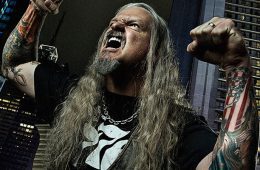
Metal Covenant recently conducted an interview with ICED EARTH guitarist/mainman Jon Schaffer. A couple of excerpts from the chat follow below.
Metal Covenant: In my point of view, the new ICED EARTH album, "Plagues Of Babylon", has definite resemblances to your latest album, "Dystopia". Was this like a conscious choice from your side or did you just write an album in the ICED EARTH vein?
Jon: Well, it's just an album in the ICED EARTH vein. I mean, the same approach was taken that we did to "Dystopia", so it's just another chapter. You know, it's what happens naturally; every record is. If you start doing something that's too contrived, then it becomes something that's not natural. Whether people get it or not, you know that's another issue, but we have to do what we're feeling at the time.
Metal Covenant: The first half of the album is a concept story. What happened then, did you run out of fuel or inspiration?
Jon: No, I just decided very early on that there's no reason to devote the entire album to this chapter of the "Something Wicked" story. I felt like we can tell it for five or six songs and we already had things like "Peacemaker" that wouldn't fit at all in the story, and I already had the music for "Cthulhu". It was different, you know. Different things were happening, and the decision to do "Spirit Of The Times" from SONS OF LIBERTY and to finally be able to do "Highwayman" with my brother singing on it, you know, that was like a big deal, so it didn't make sense to have a full concept album where "Highwayman" wouldn't have fit. It's very different, you know. It's kind of like an old RUSH record; that was the idea. Lke, "2112" was a concept on one side and on the other, it's individual tracks. Early on, that was decided.
Metal Covenant: Do you ever reflect on what's published about your new albums — you know, reviews and stuff?
Jon: I've seen some, but I don't really care. I really care more about what the fans say and I meet them and talk to them. What journalists say, I don't care. It really doesn't make any difference to me whatsoever, because it's like a lot of journalists, especially the guys that have been doing this a long time, they're so jaded and they hear so many new records. In the end, a lot of them don't even have a fresh, legitimate opinion as far as I'm concerned, so they don't really count, you know what I mean?! At the end of the day, it's the people who buy the music, who consume the music, who are the ones who pay the bills for me. Those are the fans, the people I care about. And as I said, you can tell from Facebook comments and from a lot of whatever's been put out on YouTube and stuff, the fan base is really happy. But journalists, why worry? I mean, it's really a waste of time.
Metal Covenant: ICED EARTH is like your band, it's your kind of solo project and has been for a long time. What's the best about being in a situation where you can make all the calls?
Jon: I don't really look at it that way. It's not a solo project, SONS OF LIBERTY is a solo project, you know. But I've always been the leader of this band and always will be. I mean, it's my vision and it has been since the mid-'80's. It's the thing I've been chasing all along. It's a battle, especially in the early days. The contractual conditions we were under were brutal and I don't think most people would have survived through
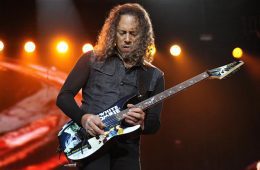
In the latest issue of U.K.'s Metal Hammer magazine, METALLICA guitarist Kirk Hammett was asked if it's strange to him how much METALLICA has eclipsed the other "Big Four" bands of 1980s thrash metal — SLAYER, MEGADETH and ANTHRAX — in terms of commercial popularity.
"I try not to spend too much time thinking about stuff like that because whatever I think of is still not going to be a satisfying enough explanation," he replied. "It's just the way things are and how the chips fell.
"EXODUS [Kirk's former band and the group many think should included if the 'Big Four' were expanded and considered the 'Big Five'] in the '80s had some bona fide problems, but I think their first album [1985's 'Bonded By Blood'] is just as good as [METALLICA's debut] 'Kill 'Em All'. We were just playing the music we wanted to hear because no one else was playing it and it wasn't being played on the radio. It was only a small group of people who knew about it and it was almost elitist in that 'No posers allowed!' thing."
MEGADETH mainman Dave Mustaine last year spoke to Radio.com about which band should have been included if the "Big Four" were expanded and considered the "Big Five". Mustaine said: "You know, people will say there's a whole another generation, like the 'Medium Four' [laughs], and I think there's a lot of great bands that fit that bill, too. But I think probably EXODUS, because there was nobody else at the time that had that kind of pull or that kind of importance in the metal community. Granted, it was with [late EXODUS singer Paul] Baloff, and Baloff had a voice that you had to have an acquired taste for, but you know, I liked him."
In a 2010 interview with Metal Asylum, EXODUS guitarist Gary Holt was asked if he feels the "Big Four" should have been expanded and considered the "Big Seven", including EXODUS, TESTAMENT and OVERKILL.
"Well, I think it should be the 'Big Five' with EXODUS, because we were there at the start of thrash metal with METALLICA in the real early '80s," he said. "Same thing with MEGADETH because [Dave] Mustaine was a part of METALLICA's birth and he also created MEGADETH. And SLAYER are SLAYER. ANTHRAX are also great and old friends, but if you listen to those first few records, they have definitely changed. TESTAMENT has every right to be part of the thrash metal legends, but it just came down to timing because they came later. And OVERKILL have been their since the beginning also. But I don't get hung up on that shit, because I know how it all started and I know where I was when the shit got created. We [EXODUS] certainly deserve to be part of the founding fathers, but you know who often gets excluded are the Germans — KREATOR, DESTRUCTION and SODOM. Everybody looks to America and forgets those guys. KREATOR, DESTRUCTION and SODOM all released records in the early '80s."
He continued: "Really, the "Big Four" is solely based on sales and the ones who sold the most. But if you compare records, I will put EXODUS' last few albums up against anybody's shit. SLAYER is always awesome; the last TESTAMENT album [at the time of the interview], 'The Formation of Damnation', was great; the new MEGADETH [2009's 'Endgame'] is one of their best; METALLICA are still finding their feet again, and their last album, 'Death Magnetic', was a step in the right direction. The new OVERKILL, 'Ironbound', is one of their best records ever; it's so good. And KREATOR, DESTRUCTION, and SODOM still make great new music. What I think it boils down to is the bands who've been doing this the longest still can do it the best. METALLICA are still a mighty force live, but they lost their way for quite a while. But then again I've never had to deal with the horrible problem of having millions of dollars. [Laughs] Maybe if I had that kind of money, it would distract my hunger for doing this kind of shit, too. But, unfortunately for me, I have to keep kickin' people in the teeth, I don't have the funds to go art-shopping. My version of fine art is a new edition of Hustler magazine. [Laughs]"