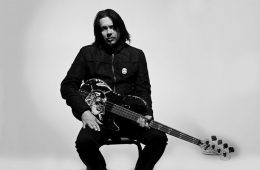
Metal Blast recently conducted an interview with CANDLEMASS and AVATARIUM mainman Leif Edling. A couple of excerpts from the chat follow below.
Metal Blast: Considering the success of CANDLEMASS and the fact that it stands proud as THE doom metal band, what led you to start AVATARIUM?
Leif Edling: My last year was very stressful, and I needed a break. The guitar became the vehicle for that. I sat on the sofa, playing guitar just trying to relax because I needed a few months to myself. I started to like some riffs, and those riffs became songs, and I needed to record those songs that I had. My friend Marcus [Jidell; EVERGREY, ROYAL HUNT] here at the studio not too far away where I live now, he's got a small studio, so we sat there and demoed the songs that I had. So that's how it started… me needing break. [laughs]
Metal Blast: I agree that it does represent a difference from CANDLEMASS; while it maintains the slow tempo, it's also more psychedelic or maybe stoner in terms of sound, and the lyrics aren't quite as dark as in CANDLEMASS, they're a little more poetic. This goes very well with Jennie-Ann Smith and her style of singing, you know, this jazzy vibe that she gives the songs. While it's taking a break in the sense that you're not working with the same band that you've worked with all these years, is it also therapeutic in that you touch on things that are not as dark as what you're usually writing?
Leif Edling: Yeah, man. I enjoyed writing these songs very much because I could work in a little bit broader scope when compared to CANDLEMASS. I could go "outside the box" a little bit more and write these relaxed verses and have some kind of bluesy feels in the vocals, like you said "jazzy." It's been kind of interesting for me to go outside the stuff that I normally do with CANDLEMASS and work a little bit more with the energy and atmosphere. As a songwriter, to me that is really interesting, because you can do something that you can't usually do. For instance, normally I don't like piano verses or verses like the one in "Moonhorse" where it's almost folk.
Metal Blast: But you're still unable to leave CANDLEMASS fully on the side. You mentioned "Moonhorse" which has this whole "folky" and psychedelic element, but at the same time these folk elements are "interrupted" by the harder CANDLEMASS doom sound. I thought this combination was great.
Leif Edling: Thanks! This was the whole purpose of the AVATARIUM album, to create something that was a little more organic. Something that not only had hard energy, but also soft energy. We worked pretty hard with the arrangements and tried to make the songs flow in a way that gave in to more atmospheric, more bluesy elements, sometimes a little dark, sometimes a little light. It was great to work with the different energies and atmosphere's and doom riffs [laughs] and even, sometimes, a little bit more progressive stuff. I'm just a fan of good music. Working with someone like Jennie-Ann Smith was great, because she can really sing the blues. She's a blues singer.
Metal Blast: In an interview, you mentioned her being able to reach sort of a "Ronnie James Dio sound," which reminds me of the fact that when you released the mini-LP for "Moonhorse", you had a cover of "War Pigs" (BLACK SABBATH]. When you're tackling such a classic song by a band as famous as BLACK SABBATH, and you give it a completely new sound, was there a bit of fear of how people will compare it to the original, and also how people will react to the re-imagining?
Leif Edling: Yeah, that's the trickiness. It doesn't matter how you do it; if you do it in the traditional way, people either complain and say, "Yeah, yeah, you can't do it like SABBATH, you're not as good and it's boring," and if you do an acoustic version, people will say, "Yeah… it's cool, but I don't get it. They should have done a traditional version." You can't please everybody. In the end, you can only do it for yourself. When we were talking about it, we said that there was no way we could really do "War Pigs", since is such a classic song that you simply cannot touch the original, it can't be done. The only thing we could do with it was to make it our own. We completely re-did it, and I love it. We've had a couple of complaints, but we've also had a bunch of people saying that it was a great cover and that we did the right thing.
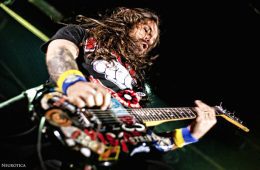
David E. Gehlke of DeadRhetoric.com recently conducted an interview with SEPULTURA guitarist Andreas Kisser. A few excerpts from the chat follow below.
DeadRhetoric.com: Since you're working with Ross [Robinson] again, it makes one think of the first time you recorded with him, which is when down-tuning became really big with bands like KORN and the DEFTONES doing it. Max [Cavalera] was always a big proponent of it; were you as well?
Kisser: At the beginning, not much. I was skeptical of the low tuning because bands like KORN or the DEFTONES, they don't have the fast pace of SEPULTURA's music. I was concerned to lose that kind of fast ability and the picking, the heavy picking on sloppy, low strings. But there are so many possibilities of using heavier-gauge strings, which give that kind of tension, and you don't lose that ability to play fast. "Trauma Of War", the song that opens the [new SEPULTURA] album, it's in low tuning, but it's a very fast song, but we don't lose that kind of ability. I learned how to do deal with that, and you open a lot of worlds in music, but yeah, at the beginning I was a little skeptical.
DeadRhetoric.com: Your very first meeting with Derrick, what do you remember the most about it?
Kisser: It was great. He came down from the States to Brazil because we were holding auditions with different people in Brazil. Derrick came down after the demo and he did "Choke". I have "Choke" with so many different singers [including Marc Grewe of MORGOTH; Phil Demmel of MACHINE HEAD and VIO-LENCE; Jason "Gong" Jones of DROWNING POOL; and Jorge Rosado of MERAUDER) some day I'll release it with all the different versions. Even Chuck Billy from TESTAMENT, he did a tryout. It was interesting the way he sang "Choke" and stuff. It would be cool to put it out some day. Derrick was for the future, though. We weren't looking for somebody similar to Max, or trying to replace him with a clone. Different visuals different attitude we liked Derrick we felt he could really grow up and be into simple terms is it, which he did. His vocals are great, he's very diverse, he can do melodic stuff and aggressive shit, and he hardly loses his voice. He's very professional and he takes care of his voice on tour and everything. He's great. He's a guy who is also very intelligent. We talk a lot about different movies, documentaries, books, and we do lyrics together. We come up with song titles, concepts, and everything. He's a great partner in that respect.
DeadRhetoric.com: Personality-wise with Derrick, did you guys connect fairly quickly?
Kisser: I think it was different for him. He came to Brazil, replacing Max Cavalera, which was very hard in the beginning — being black as well in such a racist society everywhere in the world, not only in America. It's great that he was able to face all this with great courage and great professionalism. SEPULTURA as well, with somebody like him in the band, and we said what we always said, that we're for justice and equality, and respect. We live that; we not only say that for the lyrical purposes. We really are what we are. He was the best choice for us. He's a guy who could understand the SEPULTURA way of living, of hard touring everywhere and we can survive in a bus together without wanting to kill each other and stuff. [laughs] We have the same type of ideas and conversations. I think Derrick was the perfect guy for us, and it shows.
DeadRhetoric.com: The big vocalist search in 1997 and '98, was your head spinning from all the submissions?
Kisser: Oh yeah, definitely. Right after Max left at the end of '96, back in January and February of '97, me, Igor [Cavalera, drums], and Paulo [Xisto Pinto Jr., bass] got together and started writing new stuff. We didn't want to play any old stuff. We didn't want try people out on something like "Refuse/Resist". That would be too easy, so we wanted to see the new guy singing something he never heard before; we wanted to see his input and his ideas and his possibilities with the vocals. We took eight to nine months just as a trio. We had the idea of staying as a trio, me being the singer and I even took vocal classes and tried to do demos, but I sing like crap. [laughs] I was the first singer of SEPULTURA that received a "no." [laughs]
DeadRhetoric.com: I've seen and heard you do backup vocals — you don't have a bad voice.
Kisser: I can use my voice fairly well, I can scream, but to be a singer and to embrace it, it's much more than having a good voice. You have to embrace something different. I am a guitar player. I didn't want to lose my guitar playing time just to embrace something that I am not. I don't want to force the situation. The trio time was great — we didn't do any live shows or anything, but we were practicing and trying out stuff, putting our heads in place, without making any big decisions with the turmoil that was going on. We resolved everything with Max, we signed all the papers, he's out, he didn't want anything to do with SEPULTURA. He left, and we started looking for a new singer. Then when Derrick came at the beginning of '98, he moved out to Brazil, and we started our journey.
You can read the entire interview at DeadRhetoric.com.